Introduction
You have a logo. Maybe you employed a freelancer for it, or used an online logo maker. It looks fine. But something feels off...
Your website doesn't quite match your business cards. Your social media posts look different from your brochures. Your team keeps asking "which version of the logo should I use?" And deep down, you know your brand doesn't feel as professional as it should.
Here's the truth: A logo is not a brand. A logo is just one piece of a much bigger puzzle.
If you're serious about growing your business, you need more than a logo. You need a complete brand identity system. Let us show you what that actually means — and why it matters for your bottom line.
What Most Business Owners Get Wrong
Many business owners think branding begins and ends with a logo. They hire a designer, get a logo file, and call it done. This is a mistake.
A logo identifies your business. It's a symbol people recognize. But brand identity is what people experience. It's the complete visual and emotional system that surrounds that logo.
Think of it this way: A logo tells people what you're called. A brand identity tells them who you are, what you stand for, and why they should choose you.
One is a name tag. The other is a personality.
What is Included in a Brand Identity System?
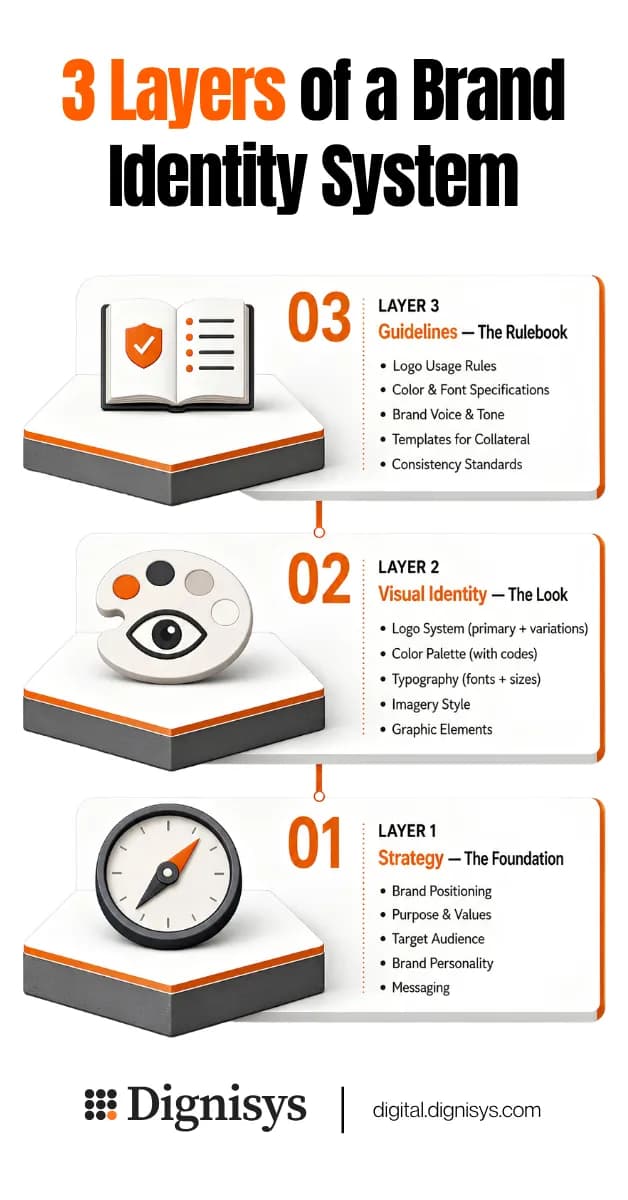
A complete brand identity system has three layers: strategy, visual identity, and application guidelines. Here's what each layer contains.
Layer 1: Brand Strategy (The Foundation)
Before any design work begins, we need to understand who you are and where you're going. This is the strategic backbone that guides every creative decision. If you have a clear answer for all of the questions below, then you have a brand strategy.
Brand Positioning
Where do you fit in the market? Who are your competitors? What makes you different? A clear positioning statement serves as your internal compass. It shapes how you present yourself and how customers see you.
Where do you fit in the market? Who are your competitors? What makes you different? A clear positioning statement serves as your internal compass. It shapes how you present yourself and how customers see you.
Brand Purpose and Values
Why does your company exist beyond making money? What do you believe in? These aren't just nice words for a website. They guide every decision you make.
Why does your company exist beyond making money? What do you believe in? These aren't just nice words for a website. They guide every decision you make.
Target Audience
Who are you actually trying to reach? What do they care about? What problems do they need solved? To build a brand that resonates, you need to understand who you're talking to.
Who are you actually trying to reach? What do they care about? What problems do they need solved? To build a brand that resonates, you need to understand who you're talking to.
Brand Personality
If your brand were a person, what would they be like? Professional? Playful? Bold? Trustworthy? This personality shapes everything from your visual style to how you write.
If your brand were a person, what would they be like? Professional? Playful? Bold? Trustworthy? This personality shapes everything from your visual style to how you write.
Brand Messaging
What do you say and how do you say it? This includes your tagline, value proposition, and key messages. Messaging pillars are the core themes that bring your positioning to life.
What do you say and how do you say it? This includes your tagline, value proposition, and key messages. Messaging pillars are the core themes that bring your positioning to life.
Layer 2: Visual Identity (The Look)
This is what most people think of as "branding". But as you can see below, even visual identity is far more than just a logo.
Primary Logo and Variations
Your main logo is just the start. You also need horizontal and vertical versions, a simplified icon version for small spaces (like favicons), and maybe a monogram version. Each version has specific rules about when and where to use it.
Your main logo is just the start. You also need horizontal and vertical versions, a simplified icon version for small spaces (like favicons), and maybe a monogram version. Each version has specific rules about when and where to use it.
Colour Palette
Colours trigger emotions. Your palette includes primary colors (your main brand colors) and secondary colors (for accents and backgrounds). There are specific colour codes for every application — HEX for web, RGB for screens, CMYK for print.
Colours trigger emotions. Your palette includes primary colors (your main brand colors) and secondary colors (for accents and backgrounds). There are specific colour codes for every application — HEX for web, RGB for screens, CMYK for print.
Typography
Fonts carry your words and set a tone before anyone reads them. Your typography system defines which fonts to use for headlines, subheadings, body text, and more. It includes font sizes, weights, and spacing rules.
Fonts carry your words and set a tone before anyone reads them. Your typography system defines which fonts to use for headlines, subheadings, body text, and more. It includes font sizes, weights, and spacing rules.
Imagery Style
The photos you use on your website and other assets form part of your brand’s visual identity. Imagery guidelines cover photography style, illustration style, iconography, and even how images should be cropped and filtered.
The photos you use on your website and other assets form part of your brand’s visual identity. Imagery guidelines cover photography style, illustration style, iconography, and even how images should be cropped and filtered.
Graphic Elements
These include patterns, textures, icons, and other visual devices that add personality to your brand. They're the visual "flavor" that makes your brand unique.
These include patterns, textures, icons, and other visual devices that add personality to your brand. They're the visual "flavor" that makes your brand unique.
Layout and Grid Systems
This governs how you arrange elements on a page. Consistent spacing, alignment, and proportions create a professional, polished look.
This governs how you arrange elements on a page. Consistent spacing, alignment, and proportions create a professional, polished look.
Layer 3: Brand Guidelines (The Rulebook)
A brand style guide is your central reference document. It documents every element above and provides clear rules for how to use them. This includes:
- •Logo usage rules (size, placement, clear space, what NOT to do)
- •Color palette with all color codes
- •Typography system with font specifications
- •Imagery and photography guidelines
- •Brand voice and tone guidelines
- •Templates for common assets
- •Application examples (business cards, social media, presentations)
Without these guidelines, your brand falls apart. Different people create different versions. Consistency disappears. Your brand starts looking like a patchwork of disconnected pieces.
Why is a strong brand identity important for businesses?
A complete brand identity system isn't just about looking good. It delivers real business results. Consistent branding can increase revenue by up to 20%. But why is this?
Trust. When your brand looks and sounds the same everywhere, people recognize you instantly. Consistency signals professionalism and reliability. Inconsistency makes you look disorganized.
Efficiency. With clear guidelines, your team spends less time asking questions and more time getting work done. No more "which font is this?" No more "is this the right logo?"
Growth. A consistent brand identity means your reputation travels with you. When you enter a new market or launch a new product, people recognize you faster and trust you sooner.
Higher prices. A strong brand commands premium pricing. People pay more for brands they trust and recognize.
Better marketing ROI. Every piece of marketing works harder when it's backed by a cohesive brand. Your ads, website, emails, and social posts all reinforce the same message.
The Gap: Logo vs Brand Identity System
The logo vs brand identity difference couldn't be starker. There's a huge gap between "getting a logo made" and building a complete brand identity system. The table below shows what you actually get with each option. Which one sounds like a better investment for your business?
| What You Get | Quick Logo Job | Full Brand Identity System |
|---|---|---|
| Logo Design & File Delivery | ✅ (One primary file) | ✅ (Multiple variations + formats) |
| Basic Color Palette | ✅ (A few colors picked) | ✅ (Complete palette with codes for web, print & digital) |
| Brand Strategy & Positioning | ❌ | ✅ |
| Comprehensive Brand Guidelines | ❌ (No rulebook) | ✅ |
| Business Collateral & Templates | ❌ | ✅ |
| Consistency & Scalability for Growth | ❌ | ✅ |
Dignisys Brand Identity Design Services: What We Deliver
At Dignisys, we don't just design logos. We offer comprehensive brand identity design services for your business – something a freelancer or AI tool simply can't match. Our branding experts deliver:
- •Brand Strategy & Positioning — We help you define who you are, who you're for, and why you matter.
- •Visual Identity Design — Logo systems, color palettes, typography, imagery direction, and graphic elements.
- •Brand Guidelines — A comprehensive document that keeps your brand consistent across every touchpoint.
- •Brand Collateral — Business cards, letterheads, email signatures, presentation templates, social media templates, and more.
- •Digital Assets — Website design, social media graphics, and digital marketing materials that extend your brand online.
The Bottom Line
Your logo is not your brand. It's just the beginning.
If you want to build a business that people recognize, trust, and choose over competitors - you need more than a logo. You need a complete brand identity system: strategy, visuals, guidelines, and collateral working together as one cohesive whole.
Don't settle for a quick logo that leaves you with more questions than answers. Invest in professional brand identity design services – get a system that actually works for your company.
Ready to build a brand that means business? Contact Dignisys today.